Wednesday, 4 September 2024

DMV update


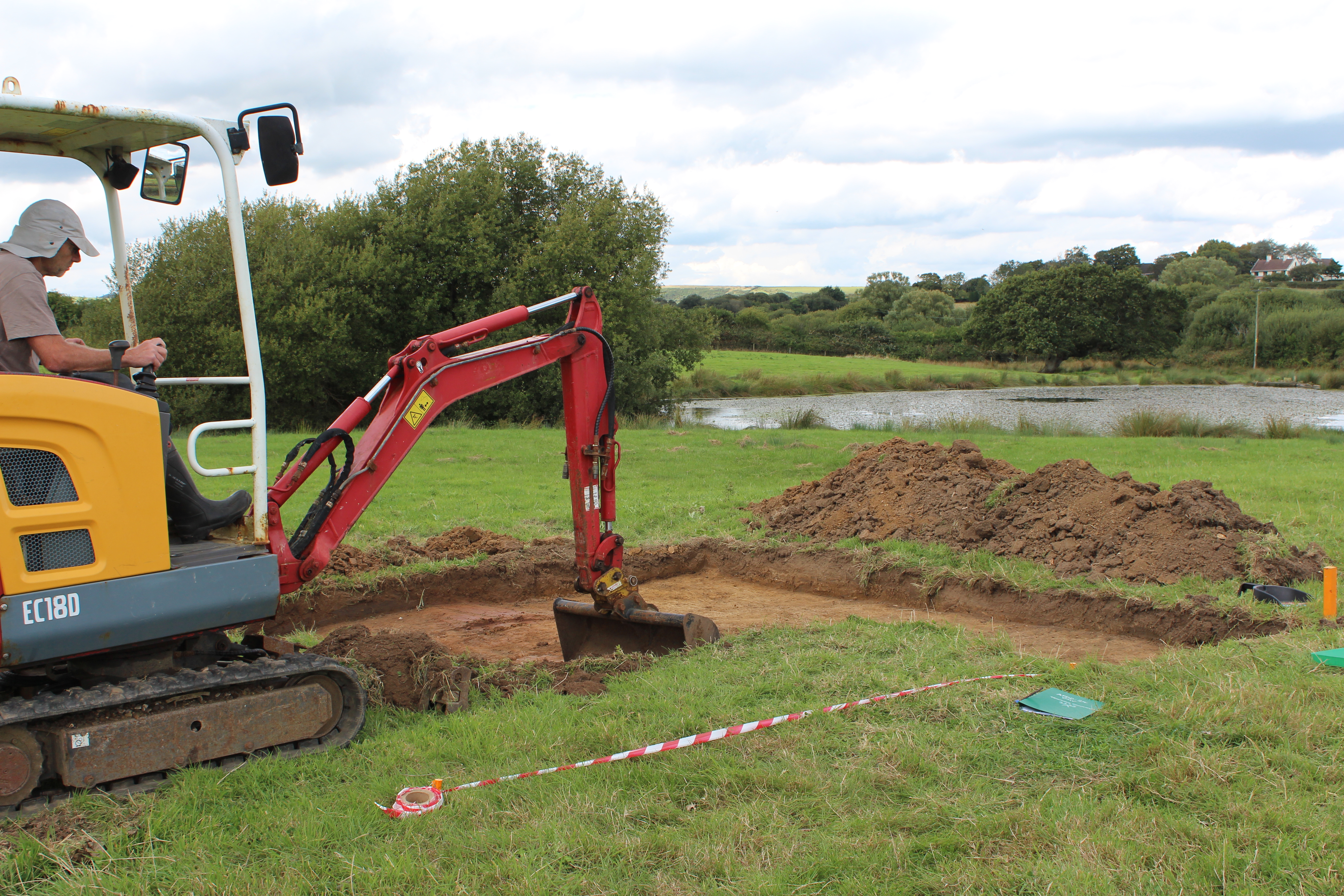
At the DMV site today we opened up a 2m x 5m trench and pottery started to come up very quickly, along with some features. 


So we then expanded the trench to 5m x 5m.


We then cleaned the base of the trench to highlight the features, these being a possible linear feature, two burnt clay areas and a dark semi-circular patch with concentrated charcoal inclusions. 


Considering that this is primarily supposed to be a medieval site these pottery examples look very early, but we will let an expert have a look and finalise the dates for all the fragments we found.   

There are now features to be dug and we will be back on site soon. 


Saturday, 31 August 2024

Stone me!


We were looking for a possible Roman road on the high ground above the village, part of helping the Charmouth History Society in their researches. This is part of a project that will include small excavations in the village next year. However, as with much of archaeological research, nothing was found other than made up ground. Even so, local members were happy with their hours digging and being part of the project and both Groups are now going to plan The Big Garden Dig over the winter. This partnership will work to add more information to the story of this ancient settlement on the coast of Dorset.     

If at first you don't succeed...

After the disappointment of the first field at our DMV site on the Purbecks revealing that no archaeology existed there, we have now moved on to the next field and undertaken some more geophysics. This has proven to be more fruitful and some features have been identified.

A darker T-shaped signal may indicate the two house platforms that are located outside the scheduled area of the DMV and next week we are now going to excavate a trial trench to locate these features. We shall report our finding here. Fingers crossed.   


Wednesday, 15 May 2024

Pole position on the Grid


The Deserted Medieval Village (DMV) site on the Purbecks has had it's grid set out. The surviving house platforms are a scheduled monument, but we are looking at the area nearby to see if any sign of structures can be had in non-scheduled parts of the field.   


One interesting sign of activity are blocks of worked stone that are not natural to the area. Why are they here? Hopefully they are the remains of a building that once stood on the site, perhaps a chapel, as the common dwellings would have been of wood. 

We are planning to start work on the site a.s.a.p., so stay tuned.   

Tuesday, 30 April 2024

There we was, digging this 'ol...

Sherborne Bridewell

Three teams worked on the Sherborne Bridewell over three weekends looking for any structures that may have been connected to this early workhouse. Originally, the area was dominated by the Sherborne Monastery and the building we were investigating may have been a vicarage or priest's house for the church of St Andrew (long gone). It was turned into a 'Bridewell' which held various vagrants and people that would have been helped before the closing down of the the many religious establishments in the 16th century. The original was built in the parish of St Brides in London. It became a private house in 1794.


We undertook a geophysical survey in the gardens of the buildings (two dwellings) and a small survey in the garden fronting the buildings. Being a small area the results were not that clear. But we decided that two test trenches may bring up something of interest.


The first trench helped us to understand that the area was made up of 600mm of made-up ground and homogenous from top to bottom. The second trench in the next garden was also made-up ground and also 600mm deep. Plenty of small finds of various materials were turning up, but the only artefact of any age was a nice 17th century pipe bowel. The rest were either 19th or 20th century. The material in the second trench did prove to be sitting on a layer with plaster inclusions, but we could not excavate 600mm of dirt in such a small garden; the spoil heap would have been quite large and we did not want to do damage to the rest of the garden. 

As always with archaeology, you never know what is under the grass until you dig it!   


Sunday, 18 February 2024

AGM 2024

 The DDCAG AGM took place and we discussed the forthcoming sites that we will be working on this year.

The DMV in East Dorset was presented as an exciting opportunity to research an important area of settlement in the county over several years. Our first job will be a geophysical survey and then we will concentrate on an area where features are located. 

Our collaboration with Bournemouth University will continue, as we look at an Iron Age/Roman site, with the geophysical survey done and test pits to follow. 

We are about to start our investigation at the Bridwell site on Sherborne. The geophiz showed some features that may be cess pits, so we will open a couple test pits. It is a well known trope that humans will always fill any holes in the ground with rubbish, and rubbish is our game! 

Close to Dorchester we will look at a site that was investigated in 2006, which found a Bronze Age burial in a garden. The owners now wish to see if any other features are there, so more test pitting for us.

We are in touch with two museums in Dorset, where we will be undertaking collaborations.

More walks and talks are planned, one walk being in Thorncombe Woods walking the Roman road and then looking at two Bronze Age barrows.    

We are hoping to have geophysical training days for members, so that we have a broad base of trained people for any sites we work on in future.

2024 is looking busy for our group and we look forward to doing some great research onto Dorset's past.

Tuesday, 16 January 2024

Sherborne Survey


We undertook a geophysical survey in Sherborne last week, looking for any evidence of structures and features behind buildings that date back to the 15th century. We are now planning to do one or two test pits looking at features that will hopefully contain dating evidence relating to pre- and post-dissolution activity on the site, thus adding information on this area to the archive.   

Coining it.

Fragment of Durotrigian bronze coin. Fragment of Roman broach. Roman balance weight. House of Constantine bronze Roman coin - reverse showin...