Wednesday, 2 October 2013
Website
DDCAG now has a functioning website where you can see all our activities and pictures as well as being able to leave comments and questions. See the latest news of our visit to Eggardon Hill Iron Age hillfort. Just put Dorset Diggers into a search engine and you will find us.

Friday, 20 September 2013
Caught Knapping

Here is a report from our member Dave:
"A dozen Dorset Diggers gathered together last Saturday in a secret corner of Bridport - the walled garden of the WI's hall - to find out how flint tools were manufactured in prehistory. Our tutor, Anthony, proved to be excellent value for money, being both very knowledgeable about his subject as well as an expert knapper in his own right.

Working chronologically from the very earliest tools - largish pebbles struck in order to produce a sharp edge, through bifacial hand-axes typical of the palaeolithic, to barbed and tanged arrow heads of the bronze age, he explained the principles of knapping - what sort of stone to use to strike the flint, where to strike it, at what angle and how hard.

He passed around many examples of his own work, which were all beautiful crafted. He explained that the techniques he used were deduced through experiment, as no description of how it was originally done has survived in any form.


Best of all, and this was something I hadn't expected when I signed up for the afternoon, we ended with a practical session. We all selected a piece of leather to drape over our thigh, our own hammer stone, our own piece of virgin flint and, not to forget: some safety goggles. I was just getting the hang of it when I had to rush off, as my ticket was about to run out in the car park.

I am now the proud owner of a mis-shapen piece of flint, but it does show some good bulbs of percussion and conchoidal fractures, so I'm happy.
So a big thank you to Anthony for his enthusiasm, expertise and willingness to lug a ton and a half of flints, stones and antlers through the streets of Bridport in order to give us a thoroughly informative and enjoyable afternoon."
And a letter from another member:
"It was absolutely brilliant today, I cannot thank you enough for organizing it. How lucky are we to be able to do that. Anthony was very good and explained it so well. I would love to do it again if you are thinking of arranging another session in the future."
Saturday, 14 September 2013
An arrowing day.

Here's a nice little artefact not seen very often by archaeologists. Yep, a £2 coin. Not much less than our hourly rate. The other is a Late Neolithic leaf-shaped arrowhead found on a site I am working on at the moment. This came up under the digging machines bucket! One needs sharp eyes in this job.
Monday, 12 August 2013
Ham Hill visit
Sunday 11th August was the visit to the Ham Hill excavation being carried out by Cardiff and Cambridge Universities and Cambridge Archaeology Unit.
The hillfort at Ham Hill is the largest in the UK, with almost 3 miles of ramparts enclosing 88 hectares. 'Hillfort' is a bit of a misnomer, in that although on hills they are not forts in the wild west tradition and not really for purely of a defensive function. They were probably for status, foci for the community or ritual and market complexes. Ham Hill is protected by English Heritage, who gave consent for the quarry extension to enable the supply of ham stone required for the conservation of the regions historic buildings.
Topographic and geophysical surveys show that 40% of the hillfort's interior has been quarried, but has revealed a multi-period occupation which includes roundhouses, roadways and substantial enclosures. This year excavators have concentrated on one of the enclosures and trenches positioned over the ramparts.
During the Neolithic and Bronze Ages finds of pottery and flint artefacts show that people used this area for short and long term settlement. By the Middle Bronze Age, c.1500BC, large field systems were set out and long term settlement was the norm, with quern stones to process cereal from the fields.
.jpg) In the Early Iron Age, c.800-350BC, the hillfort was constructed and densely populated, with the earliest evidence being a circular building under the rear of the rampart. They used a low ham stone wall for the building, to support the wooden and thatch roof, and it contained an intact hearth. The rest of the features in the main areas of excavation are much later, c.350-43AD. They consisted of two circular ditches, which would have surrounded the dwellings, and several clusters of pits, some of which are 2m deep. From these pits were found decorated pottery, quern stones, clay objects used in weaving, bone tools and animal remains, sometimes with human bones too. Remains of mustard seeds are normally associated with Roman period remains, but some were found here at this early date. Iron objects are rare, with a 'currency bar' being one of them. These were used as money, or so the theory goes, and cut into pieces according to value.
In the Early Iron Age, c.800-350BC, the hillfort was constructed and densely populated, with the earliest evidence being a circular building under the rear of the rampart. They used a low ham stone wall for the building, to support the wooden and thatch roof, and it contained an intact hearth. The rest of the features in the main areas of excavation are much later, c.350-43AD. They consisted of two circular ditches, which would have surrounded the dwellings, and several clusters of pits, some of which are 2m deep. From these pits were found decorated pottery, quern stones, clay objects used in weaving, bone tools and animal remains, sometimes with human bones too. Remains of mustard seeds are normally associated with Roman period remains, but some were found here at this early date. Iron objects are rare, with a 'currency bar' being one of them. These were used as money, or so the theory goes, and cut into pieces according to value.
The trenches cut through the ramparts show that at least four phases of construction can be seen. Each phase was constructed differently, using either dumps of soil or large revetment walls of ham stone. Domestic waste was dumped against the ramparts. The final rampart was at least 4m high. Roman pottery and a projectile point mark the final use of the rampart.
.jpg)
This years work is to find out if the southern rampart is of similar construction to the north and to extend investigations into the northwest where a possible unknown entrance may be found, as the rampart here was sealed by up to 1m of quarry rubble.
Pictures of the main excavation:

Thanks to Hayley for showing us around, DD members found it very interesting. This is last phase of digging on Ham Hill and it was an insight into a very rare event - a dig on a hillfort.
The hillfort at Ham Hill is the largest in the UK, with almost 3 miles of ramparts enclosing 88 hectares. 'Hillfort' is a bit of a misnomer, in that although on hills they are not forts in the wild west tradition and not really for purely of a defensive function. They were probably for status, foci for the community or ritual and market complexes. Ham Hill is protected by English Heritage, who gave consent for the quarry extension to enable the supply of ham stone required for the conservation of the regions historic buildings.
.jpg) |
| Ham Hill & excavation area |
.jpg) |
| Main excavation area with main enclosure |
.jpg)
The trenches cut through the ramparts show that at least four phases of construction can be seen. Each phase was constructed differently, using either dumps of soil or large revetment walls of ham stone. Domestic waste was dumped against the ramparts. The final rampart was at least 4m high. Roman pottery and a projectile point mark the final use of the rampart.
.jpg)
This years work is to find out if the southern rampart is of similar construction to the north and to extend investigations into the northwest where a possible unknown entrance may be found, as the rampart here was sealed by up to 1m of quarry rubble.
Pictures of the main excavation:
.JPG) |
| Senior Archaeologist Hayley introducing the site to DD members |
 |
| Hayley showing members a grain pit |
 |
| Digger showing a very nice section across the enclosure ditch |
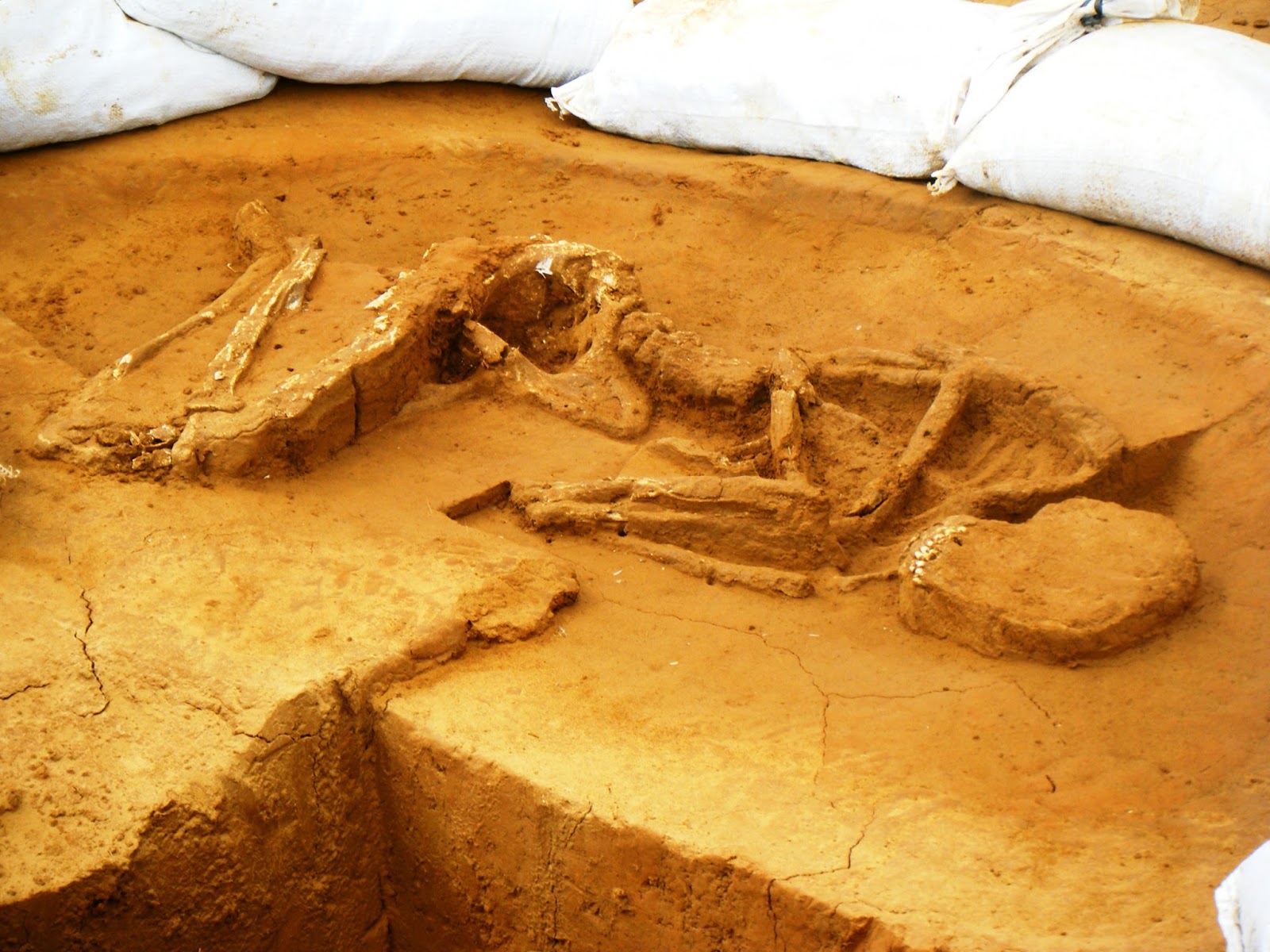 |
| A very rare find of an I/A articulated skeleton |

 |
| Find process hut |
Pictures of the rampart excavation:
 |
| Cutting through the rampart |
 |
| DD members being shown the dig at the rampart |
 |
| The slope of the rampart beyond the dig |
Thanks to Hayley for showing us around, DD members found it very interesting. This is last phase of digging on Ham Hill and it was an insight into a very rare event - a dig on a hillfort.
Drift Road event

Saturday, 20 July 2013
Thursday 25th July Event

DDCAG are having an exhibition at Maiden Newton village hall from noon until 5pm. Come and see pictures, videos and artefacts as well as visits to site.
Tuesday, 2 July 2013
Romans at Druce Farm

The Swastika mosaic is an ancient symbol from the Indian sub-continent and the Nazis stole it. As usual the Romans used many other cultural symbols for themselves, tacking other religions onto their own. At Druce Farm villa the symbol was the main decorative element. Mistakes have been found and that makes it even more interesting. One can see the human side to it much more than a perfect example.

Thursday 30th June saw some of us arrive at Druce Farm, east of Dorchester, where Lillian Ladle is working with the East Dorset Antiquarian Society excavating a substantial Romano-British villa complex. It was a trek to site in the heat but it was worth it. A large section of mosaic has been excavated and although quite plain as mosaics go, it is non-the-less impressive as a design for the room of a wealthy Romano-Britain, as it is quite probable that this was inhabited by a Romanised native of Britain.
Not much in the way of dating evidence has turned up, but some quite nice wall plaster has been found:

We were very impressed by the base of a stone column:

The ditch surrounding the villa is interesting, in that it seems to be a bringing together of Roman and British features:


Well done all the volunteers that have been working here.
Subscribe to:
Posts (Atom)
DA&HF AGM
The Dorset Archaeology & Heritage Forum had its first AGM and DDCAG was there. Lots to look forward to in the near future and 2027. Int...

-
 The last of the balusters from the ditch. some of these will make a good exhibit. Some good on-site cleaning.
 -
 Martin (left) and WDDAG WDDAG visited Martin Green's Down Farm this weekend, and what an experience it was! He took us through ...
 -
Dorset Diggers Community Archaeology Group presents TOUCH THE PAST a talk by CHRISTOPHER J. TRIPP BA (HONS) MA Stratton Village Hall...